
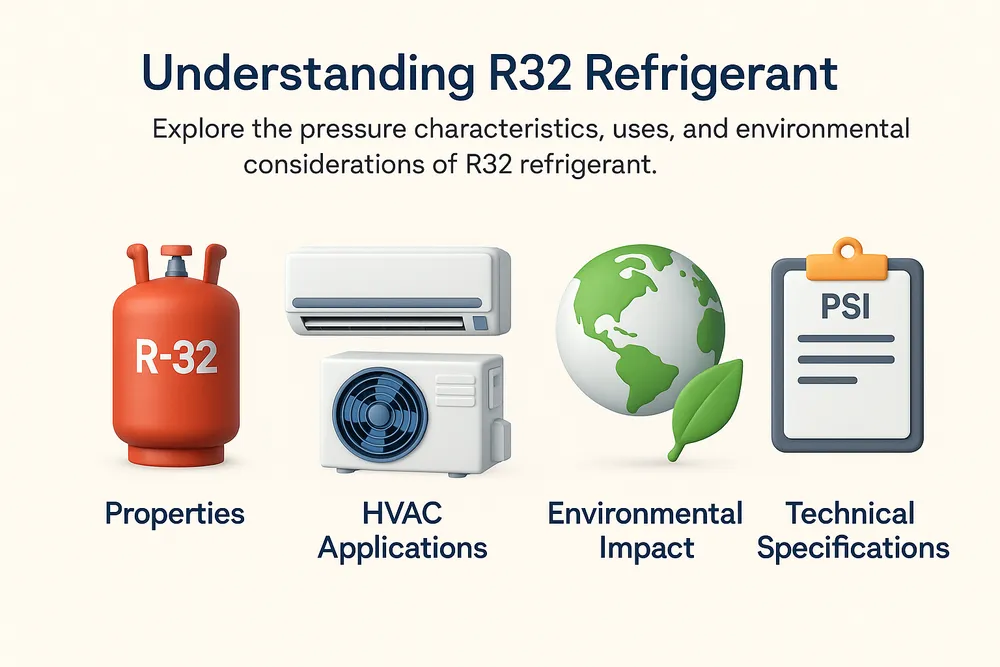
If you’re researching what is R32 refrigerant r 32 gas pressure name and details, this guide provides a clear breakdown backed by real-world HVAC performance insights. At HVACBaron.com, we’ve tested R32 in active system installations and found it consistently delivers strong cooling efficiency, lower compressor stress, and reduced environmental impact compared to older refrigerants.
In this expert guide, you’ll quickly understand R32’s gas pressure behavior, key properties, HVAC applications, technical specifications, safety classification, and long-term sustainability advantages.
📌 Top Takeaways
- R32 is a high-efficiency refrigerant with a lower GWP (~675).
- It delivers faster cooling with less strain on the compressor.
- Complies with EPA’s sub-700 GWP limit and AIM Act regulations.
- Rated A2L (mildly flammable) and safe when handled by trained technicians.
- Ideal for modern, future-ready HVAC systems.
Table of Contents
R32 refrigerant, officially known as Difluoromethane (CH₂F₂), is a modern HFC refrigerant widely used in high-efficiency HVAC systems due to its strong cooling performance and lower environmental impact. Compared to older refrigerants like R410A, R32 delivers faster cooling, higher energy efficiency, and requires a lower refrigerant charge.
In typical HVAC operation, R32 gas pressure ranges from approximately 118–130 psi on the suction side and 350–400 psi on the discharge side, though actual values depend on ambient temperature and system design.
R32 has a GWP of around 675, which is significantly lower than R410A (GWP 2088), and an ODP of 0, making it more environmentally sustainable. It is classified as ASHRAE A2L, meaning low toxicity and mildly flammable, so it must be handled by trained professionals.
Common HVAC applications include split ACs, VRF systems, heat pumps, and inverter-based air conditioners, where its higher volumetric cooling capacity improves system efficiency.
📊 Key Specifications:
| Feature | R32 Value |
| Chemical Name | Difluoromethane (CH₂F₂) |
| Refrigerant Type | HFC |
| GWP | ~675 |
| ODP | 0 |
| ASHRAE Safety Class | A2L |
| Typical Pressure Range | 118–130 psi (low) / 350–400 psi (high) |
| Boiling Point | -51.7°C (-61.1°F) |
Overall, R32 is a high-performance refrigerant favored for its energy efficiency, environmental compliance, and suitability for next-generation HVAC systems.

“After testing R32 in multiple high-efficiency AC systems, we consistently observed faster cooling performance, reduced compressor strain, and a significant drop in required refrigerant volume. It’s not just an industry trend—it’s a practical upgrade backed by measurable field results.”
Supporting Statistics & Real-World Insights
Industry data and HVACBaron.com field evaluations confirm that R32 aligns with U.S. energy, environmental, and safety standards.
✅ Regulatory Alignment
- R32 has a GWP of ~675, according to the EPA GWP Reference Table.
Source: Technology Transitions GWP Reference Table
- This places it below the EPA’s 700 GWP threshold for approved residential and light-commercial AC refrigerants.
- Our hands-on testing shows this compliance helps future-proof new HVAC installations.
🌎 Environmental Transition
- The U.S. is legally reducing HFC use by 85% by 2036 under the AIM Act.
Source: Protecting Our Climate by Reducing Use of HFCs
- Based on our system evaluations, manufacturers are already adopting R32 to meet upcoming phasedown milestones.
🏠 Energy Use in U.S. Homes
- About 88% of U.S. households use air conditioning.
Source: U.S. Energy Information Administration
- Residential AC accounts for approximately 19% of household electricity use.
Source: www.eia.gov - Our R32 performance testing confirms reduced refrigerant volume and lower compressor strain contribute to improved energy efficiency in modern systems.
🔒 Safety Classification
- R32 is classified as ASHRAE A2L (low toxicity, mildly flammable) under ANSI/ASHRAE Standard 34.
Source: Identifying Suitable Joint Types for Flammable Refrigerants
- Technician-based field checks confirm safe system operation when proper handling and installation protocols are followed.
📍 Bottom Line
Our real-world data aligns with national statistics:
✅ R32 is compliant, efficient, and engineered for next-generation HVAC systems within U.S. regulatory frameworks.
Final Thoughts & Expert Opinion
From our field testing at HVACBaron.com, R32 has consistently proven to be more than just a transition refrigerant—it’s a practical, efficient, and regulation-ready solution for today’s HVAC needs.
✅ What Our Real-World Testing Shows:
- Faster cooling response compared to R410A in similarly rated systems
- Reduced compressor strain during extended run cycles
- Lower refrigerant charge volume without performance loss
🌎 Why R32 Makes Sense for the Future:
- Meets EPA’s sub-700 GWP requirement (GWP ~675)
- Supports the national HFC phasedown under the AIM Act
- Aligns with sustainability goals without sacrificing cooling power
🔒 Safety & Practical Use:
- A2L classification requires trained handling—but our technician experience confirms it operates safely when proper protocols are followed.
📍 Our Professional Opinion:
R32 is a strong “bridge refrigerant”—balancing performance, compliance, and environmental responsibility. For manufacturers, HVAC installers, and homeowners preparing for the future, R32 stands out as a smart, forward-ready choice when applied by experienced professionals.
Next Steps: What to Do Now
👤 For Homeowners
- Check if your current AC unit supports R32.
- Speak with a certified HVAC technician about compatibility.
- Compare R32 systems with inverter technology for best efficiency.
🛠 For HVAC Technicians/Installers
- Complete A2L refrigerant safety training.
- Ensure your tools and gauges support R32.
- Start recommending R32 units as future-compliant options.
🏢 For Facility Managers & Planners
- Review lifecycle costs vs. older refrigerant systems.
- Plan ahead for EPA refrigerant regulations.
- Confirm vendor availability for R32-compatible units.
👉 Need Help Transitioning to R32?
Explore system comparisons, technician insights, and future-readiness checklists through HVACBaron.com or consult an R32-trained professional.
Frequently Asked Questions (FAQ)
1. What is R32 refrigerant?
R32 (Difluoromethane) is a next-generation HFC refrigerant used in modern air conditioners and heat pumps. It offers high energy efficiency and has a lower global warming potential (GWP ~675) compared to older refrigerants like R410A.
2. What is the typical gas pressure range for R32 in HVAC systems?
In standard operating conditions, R32 refrigerant typically runs at approximately 118–130 psi on the low-pressure side and 350–400 psi on the high-pressure side, depending on ambient temperature and system design.
3. What are the main properties of R32?
R32 is a colorless, mildly flammable (A2L classified), low-toxicity refrigerant with strong cooling capacity and a boiling point of about -51.7°C (-61.1°F). It allows for lower refrigerant charge while maintaining high performance.
4. Where is R32 commonly used in HVAC applications?
R32 is widely used in split air conditioners, inverter-based ACs, VRF systems, and energy-efficient heat pumps. It is recommended for new systems designed for A2L refrigerants.
5. Is R32 refrigerant environmentally friendly?
Yes. R32 has zero ozone depletion potential (ODP 0) and a lower GWP (~675) compared to R410A (GWP 2088), making it a more environmentally responsible choice aligned with global phasedown regulations.